Portugal Gestão Bank Card Fees Drain Cash Before You Buy a Single Pastel
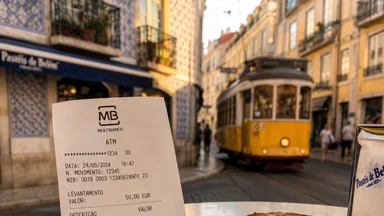
Take Marta, a Spanish teacher from Seville who planned a week in Lisbon on a tight budget of €50 per day. She arrived at Lisbon Portela Airport, found a Multibanco ATM, and withdrew €40. The receipt showed a €1.80 surcharge from her Spanish bank, plus a €2.35 line item labeled "Gestão." She had just lost 10% of her cash before buying a single pastel de nata. This experience is common for foreign card users in Portugal, where the banking system imposes fees that can add up to 7–12% on small withdrawals.
The ATM Trap That Costs You a Dinner
Portugal's banking system operates differently from most of the Eurozone. When you use a foreign card at a Multibanco ATM — the ubiquitous green machines found on every street corner — you face two separate fees. First, your home bank may charge a foreign transaction fee, typically 1–3%. Second, the Portuguese bank adds a "Gestão" fee, a fixed charge per withdrawal that ranges from roughly €1.50 to €3.50 depending on the bank and ATM location. Some estimates put the average combined cost of a €50 withdrawal at around €4–6, enough for a modest meal in a neighborhood tasca.
Dynamic currency conversion (DCC) compounds the problem. When you insert your card, the ATM offers to charge you in your home currency — dollars, pounds, or yen — rather than euros. This sounds convenient, but the exchange rate is set by the ATM operator, not the market, and typically includes a markup of 4–7%. That €50 withdrawal could cost you €53.50 before you even count the Gestão fee. Always select "Without Conversion" or the local currency option to avoid DCC. Note: Results may vary; check with your bank for specific fees and conversion policies.
The combined effect is stark. A single €40 withdrawal can easily incur €3–5 in fees, or 7.5–12.5% of the amount. Withdraw €200 at once, and the fee percentage drops to around 2–3% — still high by European standards, but less painful. The trap is that many travelers, especially those on short city breaks, withdraw small amounts frequently, multiplying the fixed Gestão charge.
Why Your Card Provider Won't Warn You
Visa and Mastercard both permit merchant surcharges in Portugal, a practice that is restricted or banned in many other Eurozone countries. When you tap your card at a café, a souvenir shop, or even a hotel, the terminal may automatically apply a surcharge of 1.5–3% for foreign cards. Some terminals also auto-select DCC without clearly asking for your consent, presenting the transaction in your home currency with a poor exchange rate.
Revolut and Wise users, who rely on low-fee international spending, are not immune. These providers charge near the interbank rate for currency conversion, but they cannot override the Gestão fee or the merchant surcharge. A Revolut user withdrawing €50 from a Multibanco ATM will still see the €2–3 Gestão fee deducted from their balance. Worse, some ATMs in Portugal now charge a flat €5 fee for all foreign cards, regardless of the amount.
Local banks profit handsomely from foreign card transactions. The Gestão fee is split between the ATM owner and the card network, creating an incentive for banks to keep the fee structure opaque. Clear signage at ATMs is rare; you typically learn about the fee only after the transaction is complete, when the receipt prints. Some ATMs display a warning screen, but it flashes by quickly, often in Portuguese only.
The lack of transparency extends to point-of-sale terminals. In many cafés and restaurants, the staff will not warn you about the surcharge. If you pay with a foreign card for a €2 coffee, you might see a €2.10 charge on your statement, with no explanation. The merchant surcharge is rarely itemized on the receipt; it is bundled into the total. For small purchases, the percentage hit is egregious.
The €1.50 Pastel de Nata That Costs €2.10 with Fees
Consider the emblematic Portuguese pastry, the pastel de nata. A typical price in a Lisbon pastelaria is around €1.50. Pay with a foreign card, and the merchant surcharge of 2% adds €0.03. If the terminal applies DCC, the effective exchange rate might add another 5%, bringing the cost to roughly €1.58. That does not sound catastrophic, but the Gestão fee does not apply to card payments — only to ATM withdrawals. However, many pastelarias impose a minimum card spend of €5 or €10, forcing you to buy more than you intended or to pay cash.
Small purchases magnify the percentage impact of fees. A €1.50 pastel de nata paid with a foreign card that triggers DCC could cost €1.60–1.65, a 7–10% premium. For a €0.90 espresso, the premium could exceed 15%. Cash remains the cheapest option for any transaction under roughly €10. Carry a mix of €5, €10, and €20 notes for daily expenses like pastries, coffee, metro tickets, and market purchases.
The Gestão fee, though limited to ATMs, indirectly affects small purchases. If you withdraw €40 and pay €3 in fees, you have lost 7.5% of your cash before spending a cent. That loss must be recovered by economizing elsewhere, or it simply reduces your budget. The traveler who withdraws €40 daily for a week loses €21 in fees — enough for a nice lunch in Lisbon.
Portuguese merchants themselves are not enthusiastic about card fees. Small shop owners in the Alfama and Bairro Alto neighborhoods often prefer cash because they avoid the 1.5–2% merchant service fee that banks charge them. Some offer a small discount for cash payments, typically 5–10% on items over €20. Asking "Desconto para dinheiro?" (discount for cash?) can save you a euro or two.
How Lisbon's Metro Fare Becomes a Hidden Surcharge
Lisbon's metro system, operated by Metropolitano de Lisboa, uses the Viva Viagem rechargeable card. To load the card at a ticket machine, you must add a minimum of €3. If you pay by credit card at the machine, the transaction may incur a merchant surcharge of 1.5–2%, and the machine may offer DCC, adding another 4–7%. A single metro ride costs €1.65, but the minimum €3 load plus fees could push the effective cost per ride to €1.75–1.85 if you only use one ride and discard the card.
Contactless tap at the metro gates is increasingly common, but it also risks DCC. When you tap your foreign card or phone at the turnstile, the terminal may process the transaction in your home currency with a poor exchange rate. The difference is small for a single ride — perhaps €0.10–0.20 — but it adds up over a week of travel. The safest approach is to buy a Viva Viagem card with cash at a metro station ticket office or a tobacco shop (tabacaria), then load it with cash at the machines.
The same applies to buses and trams. Carris, the Lisbon bus operator, accepts contactless payments, but the same DCC risk exists. The iconic Tram 28, beloved by tourists, costs €3.00 for a single ride if you buy a ticket onboard with cash. Paying by card could add €0.15–0.30 in fees. Over several rides, that is a couple of euros lost to nothing.
Beyond Lisbon, the situation is similar. Porto's Metro do Porto also uses a rechargeable card (Andante), and the same DCC pitfalls apply. In the Algarve, regional buses and trains do not always accept cards, so cash is essential. The Gestão fee at ATMs in smaller towns can be higher, as bank branches are fewer and standalone ATMs dominate.
Comparing Portugal to Spain and Italy
Portugal stands out among southern European destinations for its aggressive card fees. Spain, by contrast, has limited DCC at ATMs since a 2022 regulatory change that requires clear disclosure of conversion rates. Spanish ATMs still charge a fee for foreign cards, but it is typically lower — around €1–2 per withdrawal — and DCC is less prevalent. Many Spanish bank ATMs, such as those of major banks, offer fee-free withdrawals for certain foreign cards.
Italy's bancomat system rarely adds a Gestão-style fee. Italian ATMs may charge a flat fee of €1–2 for foreign cards, but some banks offer free withdrawals for cards of partner institutions. DCC is present at some tourist-oriented ATMs in Rome and Venice, but it is less automatic than in Portugal. Overall, Italy is friendlier to card users.
Only Greece rivals Portugal in surcharge prevalence. Greek ATMs often charge €2–3 per withdrawal, and DCC is common at both ATMs and point-of-sale terminals. However, Greece has a higher proportion of cash-only businesses, especially on the islands, so the impact is slightly different. Portugal's ubiquity of card acceptance — even small pastelarias have terminals — means more transactions are exposed to fees.
The Eurozone's lack of harmonization on ATM fees creates this patchwork. Each country's banking association sets its own interchange fees and surcharge rules. Portugal's banks have chosen a model that extracts maximum revenue from foreign cardholders, and there is little political pressure to change it. The Portuguese central bank has issued guidelines on DCC disclosure, but enforcement is weak.
Three Workarounds That Actually Work
The first workaround is to use a fee-free bank account denominated in euros. N26, Revolut, and Wise all offer accounts with no foreign transaction fees and ATM withdrawals up to a certain limit without surcharges. Revolut's standard plan allows €200 in fee-free ATM withdrawals per month, while N26's standard account offers free withdrawals at partner ATMs. However, these accounts cannot bypass the Gestão fee; they simply avoid your home bank's markup. The Gestão fee will still appear on your statement.
The second workaround is to always select "Without Conversion" at ATMs and point-of-sale terminals. When the ATM asks if you want to be charged in your home currency or in euros, always choose euros. This avoids DCC. At a café, if the terminal shows the amount in your home currency, ask the staff to cancel the transaction and process it in euros. Some terminals require the merchant to select the currency, so a polite request can save you 4–7%. Note: Results may vary; check with your bank for specific fees and conversion policies.
The third workaround is to withdraw larger amounts less frequently. A single €200 withdrawal might incur a €3 Gestão fee, or 1.5%. Two €100 withdrawals would incur €6 in fees, or 3%. Four €50 withdrawals would cost €12, or 6%. The math is clear: consolidate withdrawals to minimize the fixed fee. Carry cash for small purchases and use your card only for larger transactions where the percentage impact is lower.
Avoid Euronet ATMs at all costs. These standalone machines, found in tourist hotspots across Lisbon, Porto, and the Algarve, charge the highest fees — often €5–7 per withdrawal plus a terrible DCC rate. They are easy to spot: bright yellow or blue, with a screen that aggressively pushes DCC. Use bank-owned ATMs instead, preferably those attached to a branch. Millennium bcp and Caixa Geral de Depósitos machines inside bank lobbies tend to charge lower Gestão fees than standalone units.
One more tip: carry a backup card from a different network. If your Visa card triggers a surcharge at a particular merchant, try your Mastercard or a contactless payment from your phone. Some terminals have different fee arrangements with different networks. Also, inform your bank of your travel dates to avoid fraud blocks that could force you to use a more expensive ATM.
What Travel Blogs Get Wrong About Portugal
Most travel blogs and guidebooks focus on the pastel de nata, the azulejo tiles, and the Fado music. They rarely mention the banking fees. A quick search for "Portugal travel tips" yields articles on packing light, learning a few Portuguese phrases, and visiting at shoulder season. The Gestão fee appears in zero of the top ten results. This omission is costly for budget-conscious travelers.
Guidebooks from Lonely Planet and Rick Steves include practical advice on currency, but they often generalize: "Portugal uses the euro, same as Spain." They do not warn that Portuguese ATMs charge a fee that Spanish ones do not. The assumption that the Eurozone is uniform for banking is false, and travelers pay the price.
Influencers on Instagram and TikTok rarely touch on financial infrastructure. Their sponsored posts from Lisbon's Time Out Market or Porto's Livraria Lello do not include a line about DCC or Gestão. The real cost of a Lisbon weekend is 10–15% higher than the advertised budget once fees are factored in. A €500 trip might actually cost €550–575.
Even budget travel websites that meticulously compare hostel prices and flight deals overlook ATM fees. They calculate daily costs based on menu prices, not on the effective cost of accessing cash. A traveler who follows their budget of €50 per day might find themselves spending €55–57 due to fees, forcing them to cut back on experiences.
The irony is that Portugal markets itself as an affordable destination. Compared to France or the UK, it is cheaper for accommodation and dining. But the hidden banking fees erode that advantage. A meal that costs €15 in Lisbon might be €20 in Paris, but if Paris has no ATM fees and Lisbon adds €3, the gap narrows. Travelers deserve full-cost transparency.
To protect your budget, plan ahead. Withdraw larger amounts, always choose local currency, and keep cash for small purchases. The Gestão fee is a nuisance, but with the right strategy, you can keep your pastel de nata costs where they belong: under €2. Start by checking your bank's fee schedule before you fly, and make a note to decline conversion at every terminal.