Nairobi to Mombasa Night Bus Math: Schedules Shift by Two Hours After Dry Season
The Nairobi–Mombasa night bus is a staple of Kenyan long-distance travel, but its schedule is not as fixed as the booking apps suggest. After the dry season, which typically runs from January to March and again from July to October, departure times drift later by as much as two hours. Operators like Mash East and Modern Coast adjust their timetables quietly, responding to road conditions that improve when the rains stop. A bus that left at 7 p.m. in the wet season may not roll out until 9 p.m. in the dry months. Passengers who show up at the advertised time often wait on plastic chairs in dusty terminals, watching the sky darken. Below are the key factors to consider when planning this journey.
The Two-Hour Drift After Dry Season
The dry season transforms Kenya's highway network. The A109 from Nairobi to Mombasa, a two-lane road that carries most of the country's freight and passenger traffic, suffers less damage when the rains stop. Potholes shrink, mudslides cease, and the risk of flash floods drops. Bus companies, aware that they can make better time on dry pavement, push departure times later. A 7 p.m. departure in April becomes a 9 p.m. departure in August. The logic is simple: later departures mean fewer traffic jams near Nairobi and a smoother run through the Taru Desert at night, when temperatures are cooler and engine strain is lower. Booking apps rarely reflect this seasonal shift. When I checked the Mash East website in late 2024, the Nairobi–Mombasa night bus still showed a 7 p.m. departure regardless of the month. Local agents in Nairobi's River Road area told me that the real schedule changes about two weeks after the dry season begins. One agent, who asked not to be named because his boss does not like him sharing operational details, said: “We tell regulars to call the morning of travel. The app is for tourists.” Modern Coast follows a similar pattern. Their customer service line, when I called in August 2024, confirmed that the night bus to Mombasa was leaving at 8:30 p.m., not the 7 p.m. listed online. The agent said the change had been in effect for three weeks. When I asked why the website was not updated, she laughed. “You have to understand, the website is run from Nairobi. The buses are run from the road.” For passengers, the drift means planning a later arrival at the terminal. Showing up at 6 p.m. for a 9 p.m. departure wastes three hours in a waiting area that may lack seating or shade. Seasoned travelers bring a book and a bottle of water. They also know that the bus may leave earlier if it fills up, so they check with the conductor directly. The two-hour drift is not a guarantee; it is a tendency, and it bends further during holidays like Christmas when demand surges and buses leave as soon as they are full, regardless of the posted time.
Fare Ranges That Shift With Rainfall
Fares on the Nairobi–Mombasa route vary more than most travel blogs admit. In the dry season, when demand peaks, an economy seat on a night bus costs between KSh 1,500 and 2,000. During the wet season, when roads are worse and buses run slower, the same seat drops to KSh 1,000–1,300. The discount comes with a catch: wet-season buses fill faster because there are fewer departures, and breakdowns are more common. A traveler named James Ochieng, whom I met at the Nairobi terminal in April 2024, recounted a 12-hour journey because of a detour near Mtito Andei, where a bridge was washed out. His account is consistent with reports on the Kenya Bus Forum (a Facebook group) where multiple users described similar delays in April 2024.
Executive class, which offers reclining seats and air conditioning, adds KSh 500–800 to the base fare. Total executive fare runs KSh 2,200–2,800. The price gap narrows when you factor in the wet-season discount on economy; in the dry season, the executive premium feels steeper. Some operators, like Coast Bus, offer a middle tier called “business class” for around KSh 1,800, but availability is spotty.
Advance booking discounts are real but modest. Ticket offices in Nairobi's city center offer roughly 10–15% off if you buy at least a day ahead. Online booking, by contrast, adds a convenience fee of 50–100 KSh per ticket. The net effect is that buying at the counter with cash often beats the online price, especially if you are buying two or more tickets. One agent at the Mash East office on Accra Road told me: “Online is for people who do not want to come here. But we give better price if you come.”
Fares also spike during school holidays and around Christmas, when demand triples. A seat that costs KSh 1,500 in October may go for KSh 2,500 in late December. The increase is not always listed; some operators simply remove the economy option and sell only executive. If you are flexible, traveling on a Tuesday or Wednesday in the low season can save you 30% compared to a Friday or Sunday departure.
Another factor is the distance-based pricing variation. Some operators charge slightly more for passengers boarding in Nairobi's city center versus those boarding at the outskirts, though the difference is usually less than 100 KSh. For example, Mash East's terminal on Accra Road may have a base fare of KSh 1,500, while the same bus picking up at the Mlolongo stop (about 15 km southeast) might charge KSh 1,400. This nuance is rarely advertised but can be negotiated if you ask at the counter.
Why the Night Bus Beats the Train (For Now)
Kenya's Madaraka Express train runs from Nairobi to Mombasa in about five hours, compared to the bus's 8–10 hours. The economy fare on the train is KSh 1,000, cheaper than most bus seats. Yet the night bus has advantages that tilt the math for many travelers. The train departs only during daytime; the last train leaves Nairobi around 2 p.m. That means you lose a full day to travel, whereas the night bus departs in the evening and arrives in Mombasa around 5 a.m., letting you start your day early.
The night bus also saves the cost of a hotel. If you take the train, you either arrive in Mombasa in the late afternoon and pay for a night's accommodation, or you stay overnight in Nairobi and catch an early train. The bus eliminates that expense. For budget travelers, the KSh 1,000–2,000 saved on a hostel makes the bus cheaper overall, even factoring in the longer ride.
Train tickets sell out quickly. The Madaraka Express has a capacity of roughly 1,200 passengers per day across two classes, and seats often sell out two to three days in advance, especially on weekends. Buses, by contrast, have same-day availability on most routes. Even during peak season, you can usually find a seat on a bus, though you may have to wait for a later departure or pay a premium.
The bus also drops you closer to Mombasa's city center. The train station at Miritini is about 20 kilometers from the central business district, requiring a matatu or taxi ride that adds KSh 200–400 and 30–45 minutes. Bus terminals in Mombasa, like the one on Digo Road, are a short walk from hotels and restaurants. For someone arriving at 5 a.m., that proximity matters.
However, the train has its own advantages that the bus cannot match. It is more punctual, with delays rarely exceeding 30 minutes, compared to the bus's frequent 1–2 hour delays. The train also has a dining car, onboard toilets that are consistently clean, and power outlets at every seat. For travelers who prioritize comfort and reliability over cost and schedule flexibility, the train remains a strong contender.
The ‘Mombasa Road’ Tax: Stops, Meals, and Tips
The ticket price is only part of the cost. Every night bus on the Nairobi–Mombasa route makes a mandatory meal stop near Mtito Andei, roughly halfway. The stop lasts 30–45 minutes, and passengers are expected to buy something from the restaurant. A plate of chapati and chai costs 150–250 KSh. The food is decent, but the price is about 20% higher than at a comparable restaurant in Nairobi or Mombasa. The restaurants pay the bus companies for the exclusive stop, and that cost is passed on.
Drivers and conductors expect a tip, collected by the conductor during the journey. The amount is typically 50–100 KSh per passenger. Some operators include a tip line on the receipt; others simply ask for cash. Refusing is awkward but possible; regulars often tip 50 KSh and no more. The tip is not shared equally among crew—the driver gets the larger share—but passengers are not given a choice in the distribution.
Unofficial “parking fees” at some rest stops add 20–50 KSh per bus. These are small, but they add up. The driver usually covers them from the tip pool, so the cost is indirect. Still, the total extra cost per trip beyond the ticket is 300–500 KSh, or roughly 20–30% of the economy fare. Budget travelers should factor this into their planning.
There is also a luggage surcharge for bags above 15 kg. The official limit is 20 kg, but conductors enforce it unevenly. If your bag looks heavy, they may ask for 100–200 KSh. A traveler I met at the Nairobi terminal in August 2024 was charged 150 KSh for a duffel bag that weighed 18 kg. He had not expected the fee and had to borrow cash from a fellow passenger. The surcharge is rarely mentioned on booking sites.
Some buses also charge for blanket rental during the ride, typically 50–100 KSh. This is more common on economy buses where blankets are not included. The conductor will announce it shortly after departure, so have small bills ready. These micro-charges can add another 50–100 KSh to the trip cost.
Where the Travel Blogs Get It Wrong
Many travel blogs present the Nairobi–Mombasa night bus as a straightforward, on-time service. In reality, delays are routine, especially after the dry season when the schedule drifts. The blogs that do mention delays often attribute them to traffic, but the real cause is operational: buses wait for a full load, and the definition of “full” changes with demand. A bus may leave with 40 passengers in the low season but wait for 50 in the high season, adding an hour to the departure.
Blogs also recommend booking online for convenience, but local agents offer cash discounts that online platforms cannot match. The difference is small—50–100 KSh per ticket—but for a family of four, it adds up. More importantly, booking online locks you into a departure time that may not reflect the seasonal drift. If you book a 7 p.m. bus in August, you may end up waiting two hours for a 9 p.m. departure that you could have chosen directly at the counter.
Safety advice in blogs is often outdated. Many posts warn about theft and recommend locking bags to the seat, but newer buses have GPS tracking and CCTV cameras. Mash East and Modern Coast both installed cameras in 2023, and theft is now rare. The bigger risk is road accidents, which are more common at night. Blogs rarely mention that the dry season, despite better roads, sees more accidents because drivers speed on the smooth pavement.
Another blind spot is the luggage surcharge. Most blogs state that one bag is free, but they do not specify the weight limit. A bag over 15 kg incurs a fee, and the limit is enforced more strictly in the dry season when buses are full. Bloggers who travel with a small backpack may never encounter this, but anyone carrying a large duffel or suitcase should expect to pay extra.
Additionally, blogs often ignore the variability in bus quality. Not all buses from the same operator are identical; older models may lack functioning air conditioning or reclining seats, while newer ones offer USB ports and better suspension. It is worth asking the agent which specific bus model will be used on your travel date. For example, Mash East operates both Scania and Isuzu buses, and the Scania models are generally newer and more comfortable.
Packing for a 9-Hour Night Ride
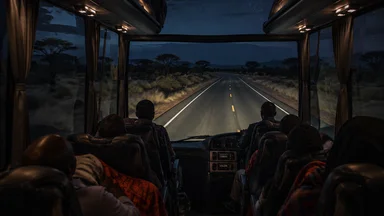
The air conditioning on night buses is aggressive. Cabin temperatures can drop to around 18°C, which feels cold after the heat of Nairobi or Mombasa. A fleece or blanket is essential. Some buses provide a thin blanket, but supply is limited; regulars bring their own. A neck pillow and eye mask are also important because the overhead lights stay on until the rest stop, which may be two or three hours into the journey. The lights dim after the stop, but they do not go off completely.
Buses provide one 500 ml bottle of water per passenger. Extra bottles cost 50 KSh, charged by the conductor. Snacks are not provided, and the rest stop may not have a wide selection. Travelers should bring their own snacks and a larger water bottle. The bus's toilet is available but often runs out of water by the halfway point; many passengers prefer to wait for the rest stop.
Power banks are essential. Based on a 2023 survey by the Kenyan tech blog TechWeez (techweez.com), fewer than 30% of night buses on this route have USB ports. The ones that do may not work consistently. A fully charged power bank can keep a phone running for the entire journey, which is useful for entertainment or for checking arrival time. The bus does not have Wi-Fi, so download movies or podcasts before boarding.
Earplugs are a good idea. The bus engine is loud, and some passengers talk on the phone throughout the night. The driver may also play Kenyan gospel music at high volume for the first hour. Earplugs or noise-canceling headphones make a significant difference. One seasoned traveler I met swore by a sleep mask with built-in speakers, which she said transformed the experience.
Another item worth packing is a small flashlight or headlamp, as the bus interior can be very dark after the lights dim, making it hard to find items in your bag. Also, bring a small bag for valuables to keep at your seat, as overhead bins are not always secure.
The Math: Should You Pay Extra for Executive?
Executive class costs KSh 2,200–2,800, roughly 50% more than economy. The main benefit is a reclining seat that goes back about 40 degrees, compared to economy's 10–15 degrees. For a 9-hour ride, that difference matters. Someone who can sleep sitting up may find economy adequate, but for most people, executive makes sleep possible. A rough calculation: if you value an hour of sleep at 100 KSh, then five hours of sleep in executive is worth 500 KSh, which is less than the premium. But if you need eight hours, the value jumps to 800 KSh, close to the premium's upper end.
For budget travelers, there is a middle option: pay 200 KSh extra for a front-row seat in economy. These seats have more legroom and a slightly better recline because they are not blocked by the seat in front. The trick is to book early or ask at the counter. Not all operators offer this, but Mash East does, and the cost is far less than executive. The trade-off is that front-row seats are near the door, which can be drafty and noisy.
Executive also includes a meal at the rest stop, which in economy you pay for separately. The meal is the same—chapati and chai—but the executive ticket includes it. At 150–250 KSh, that covers part of the premium. Some executive buses also have fewer seats per row, meaning more shoulder room. For tall travelers, that can be decisive.
Bottom line: executive pays off if you arrive in Mombasa rested for a 7 a.m. meeting or a full day of sightseeing. If you plan to sleep in a hostel until noon, economy is fine. The premium is not about luxury; it is about arriving functional. For those who can sleep anywhere, economy is a better value. For everyone else, the extra cost is worth considering, especially since the difference is roughly the same as a cheap hostel bed for one night.
However, executive is not without drawbacks. Some travelers report that the reclining mechanism can be noisy or that the seat may not recline fully if the passenger behind is tall. Also, the air conditioning in executive is often set even colder, so bring extra layers. It is worth checking the specific bus model before upgrading, as some older executive buses have worn-out seats that offer little advantage over economy.
Ultimately, the Nairobi–Mombasa night bus is a study in trade-offs. The schedule drifts, the fares shift, and the hidden costs add up. But for the traveler who understands the math—who calls to confirm the departure time, packs a fleece, and brings cash for the tip—it can be a practical option. The bus does not pretend to be comfortable, and it is not for everyone. Those who prioritize punctuality, comfort, and predictability may prefer the train, even at the cost of a longer travel day. For budget-conscious travelers who value flexibility and a pre-dawn arrival, the night bus remains a viable choice, provided they go in with eyes open to its quirks and costs.