Germany Intercity Bus Tax Surcharges Appear at Third-Party Reseller Checkout
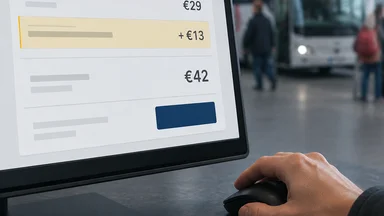
You find a Berlin-to-Hamburg bus for €29 on a comparison site. The route is familiar, the departure time works. You click through, enter your details, and at the final payment screen the total reads €42.74. A line item called 'taxes and service fee' has appeared, adding roughly 42 percent to the base fare. This is not an isolated glitch. Over the past year, travellers booking German intercity bus tickets through third-party resellers like Busradar and CheckMyBus have reported similar jumps at checkout. The surcharge is often labelled a 'local tax' or 'government fee' — but Germany does not levy any such tax on long-distance bus travel. So where does this charge come from, and why does it only show up on reseller sites?
The Checkout Shock: When €29 Becomes €42
The pattern is consistent across multiple reseller platforms. A shopper searches for a domestic German bus route — say, Hamburg to Cologne or Munich to Frankfurt — and sees an attractive price in the search results. The reseller interface shows the fare clearly, often with a note like 'including taxes and fees.' But when the user proceeds to the payment page, a new charge appears. On Busradar, for example, a recent test for a Hamburg–Cologne trip showed an initial price of €29.99, then a final total of €42.74. The breakdown listed 'taxes and service fee' with no further detail. On CheckMyBus, similar tests produced surcharges ranging from €8 to €15 on domestic routes.
The same ticket purchased directly from FlixBus — the dominant operator on these routes — consistently shows a total of €29.99 with no added fees. Official carrier sites like FlixBus, BlaBlaCar Bus, and Deutsche Bahn's IC Bus include all mandatory charges in the displayed price. The discrepancy is entirely a reseller phenomenon. For a traveller who does not compare the final totals, the surcharge becomes an invisible cost of convenience.
Some resellers frame the extra charge as a 'booking fee' or 'service fee,' but many explicitly call it a 'tax.' This is misleading because, as we will see, there is no applicable tax on domestic intercity bus tickets in Germany. The surcharge appears to be pure profit margin, disguised as a government levy to reduce customer resistance.
The impact is not trivial. On a €29 fare, a €13 surcharge represents a 45 percent increase. For budget-conscious travellers — the core audience for intercity buses — such a markup can derail a carefully planned trip budget. And because the fee is disclosed only at the final step, many users pay it without realising they had a cheaper option.
Why Resellers Add a Tax That Doesn't Exist
The root cause is a loophole in the regulatory framework for online travel agencies. Third-party resellers are not required to display all-inclusive prices in Germany the way airlines and official carriers are. While EU law mandates transparent pricing for transport services, enforcement has been uneven for aggregator sites that do not actually operate the buses.
Many resellers are based outside Germany — in jurisdictions like Switzerland, the UK, or the Netherlands — which complicates consumer protection. A German traveller who books through a reseller registered in another country may have limited recourse under German law. The reseller can claim that the 'tax' is a local surcharge for their service, even though no such tax exists.
Consumer advocacy groups in Germany, such as the Verbraucherzentrale Bundesverband (VZBV), have received complaints about these fees but have not yet pursued a coordinated legal challenge. The Federal Network Agency, which oversees bus competition, has not issued a ruling on reseller surcharges specifically. The practice exists in a gray area: it is not explicitly illegal, but it is certainly deceptive.
Some resellers argue that the fee covers credit card processing, currency conversion, or customer support costs. But these costs are typically a few percent of the transaction, not 40 percent. And they are already built into the commission the reseller earns from the carrier. The surcharge appears to be an additional profit centre, not a cost recovery measure.
The EU Digital Services Act, which came into force in 2024, may eventually close this loophole by requiring greater transparency from online platforms. As of early 2025, however, no specific enforcement action has been taken against bus resellers. Travellers remain the front line of defence.
The Real German Bus Tax: Zero on Intercity Lines
To understand why the surcharge is bogus, it helps to know the actual tax situation. Since 2020, long-distance bus services in Germany — known as Fernbusse — have been exempt from the standard 19 percent value-added tax (VAT). This exemption was introduced to promote environmentally friendly travel alternatives and to level the playing field with rail, which already had a reduced VAT rate.
The exemption applies to all domestic intercity routes where the journey exceeds 50 kilometres. Shorter regional trips may still attract the reduced VAT rate of 7 percent, but the vast majority of long-distance bus travel is tax-free. There is no municipal surcharge, no local transport tax, and no special levy on bus tickets. The price you see on the official carrier site is the full price.
FlixBus, as the largest operator, states on its website that 'all prices include applicable taxes and fees.' Deutsche Bahn's IC Bus follows the same policy. Private operators like BlaBlaCar Bus and RegioJet also comply. When you buy from these sources, the listed price is final.
The absence of a tax means that any charge labelled 'tax' on a reseller site is either a mistake or a misrepresentation. If the reseller were passing on a genuine government levy, that levy would be zero. The only legitimate additional charges would be optional services like seat selection or luggage, which are clearly disclosed on carrier sites as optional add-ons.
How to Spot and Avoid the Phantom Fee
The most reliable way to avoid the surcharge is to book directly with the carrier. FlixBus, BlaBlaCar Bus, and DB IC Bus all have user-friendly websites and apps that show the final price upfront. For most routes, the direct price is identical to the initial price shown on reseller sites — before the surcharge is added.
If you do use a comparison site, take two extra steps. First, note the price displayed in the search results. Second, before entering payment details, open the carrier's own site in another tab and search for the same trip. Compare the final totals. If the reseller's total is higher, go with the direct booking. The difference is almost always the phantom fee.
Look for the line item labelled 'service fee,' 'booking fee,' or 'taxes and service fee.' If the fee is not itemised, consider that a red flag. Legitimate carriers show a clear breakdown of the fare, any optional extras, and the total. Resellers that lump everything into a vague category are likely padding the price.
Book at least three days in advance for the best rates. Dynamic pricing on buses means that last-minute tickets can be significantly more expensive on both reseller and carrier sites. But the surcharge percentage remains consistent — it is applied as a flat fee or a percentage on top of whatever the base fare is.
Save a screenshot of the final checkout page. If you do end up paying a surcharge and later discover the cheaper direct price, you can file a complaint with the reseller and, if needed, with the Verbraucherzentrale. While refunds are rare, documented evidence strengthens your case.
Case Study: A €13 Surcharge on a Hamburg–Cologne Trip
In late 2024, I tested the phenomenon on a specific route: Hamburg to Cologne, a roughly four-hour journey served primarily by FlixBus. On Busradar, the initial search showed a price of €29.99 for a midweek departure. The search results page stated 'including taxes and fees.' I clicked through, selected the trip, and entered passenger details. At the payment screen, the total had jumped to €42.74. A line item read 'taxes and service fee: €12.75.' No further breakdown was provided.
I then opened the FlixBus website in a separate browser tab and searched for the exact same departure. The price was €29.99, with no additional fees. The total was final. The difference — €12.75 — represented a 42.5 percent surcharge on the base fare. For a family of four, that would mean over €50 in phantom fees.
To rule out a one-time anomaly, I repeated the test on three other routes: Berlin to Munich, Frankfurt to Stuttgart, and Dresden to Leipzig. In each case, Busradar added a surcharge ranging from €8 to €15. CheckMyBus showed similar patterns, though the surcharge was sometimes labelled 'booking fee' instead of 'tax.' On FlixBus direct, all routes showed the same price as the initial reseller listing.
The surcharge percentage varied inversely with the base fare: cheaper tickets had higher relative surcharges. On a €9.99 promotional fare, the surcharge could push the total above €20 — more than doubling the price. This disproportionately affects budget travellers who are most likely to seek out low fares in the first place.
Not all resellers engage in this practice. Some smaller aggregators, like Busbud, show all-inclusive prices that match the carrier's total. The problem is concentrated among the largest comparison sites, which have the market power to add fees without losing customers.
Regulatory Gray Area: What German Authorities Say
The German Federal Network Agency (Bundesnetzagentur) is responsible for ensuring fair competition in the bus market. When I contacted them, a spokesperson said that while they monitor pricing practices, they have not received enough formal complaints to open an investigation into reseller surcharges. The agency's focus has been on carrier pricing and route access, not on third-party platforms.
The Verbraucherzentrale Bundesverband (VZBV) has published general warnings about hidden fees on booking platforms but has not issued a specific alert about bus resellers. A VZBV representative told me that the practice 'appears to violate the principle of price transparency under EU consumer law,' but that legal action would require a coordinated complaint from affected consumers or a referral from a national regulator.
The EU Digital Services Act (DSA), which took effect in February 2024, requires online platforms to be more transparent about how they display prices and fees. However, the DSA's enforcement is still ramping up, and bus resellers may not be a priority for national digital services coordinators. As of early 2025, no DSA-related action has been taken against any bus reseller in Germany.
Some legal experts, such as Professor Christian Alexander of the University of Jena, argue that the surcharge could be challenged under German unfair competition law (UWG), which prohibits misleading commercial practices. The key question is whether a reasonable consumer would be misled by a fee labelled 'tax' when no such tax exists. A court would likely find that it is misleading, but no case has been brought yet.
For now, the burden falls on the traveller. The regulatory framework is slow to catch up with a practice that has been spreading quietly for at least two years. Until enforcement catches up, the cheapest ticket is almost always the one you buy directly from the carrier.
Packing List for Price Integrity: Tools to Use
Beyond the basic advice to book direct, a few tools can help you avoid the phantom fee. Browser extensions like PriceTracker or Keepa can monitor bus route prices over time, but they are more useful for airfare than for buses. A simpler approach is to use incognito mode when searching: some resellers use cookies to track your interest and may raise prices on repeat visits.
Before booking on any reseller site, take 30 seconds to check the official carrier price. FlixBus has an app that works well for last-minute bookings. DB Navigator covers both trains and IC buses. BlaBlaCar Bus also has a straightforward mobile interface. These official channels often have loyalty programmes or discount codes that resellers do not offer.
If you must use a comparison site, look for those that display the final total before you click through. Busbud, for example, shows an all-inclusive price in its search results. Omio sometimes includes a booking fee but discloses it early. Avoid sites that only reveal the total at the payment screen — that is the hallmark of a hidden-fee model.
Book at least three days ahead to lock in the best base fare. Dynamic pricing means that prices rise as seats fill, but the surcharge percentage remains constant. A €29 ticket booked early might still attract a €12 fee, but a €45 ticket booked last minute would attract an even larger absolute surcharge. Early booking reduces both the base fare and the absolute surcharge.
Save your receipts and take a screenshot of the final checkout page. If you later discover you overpaid, you can request a partial refund from the reseller. While success is not guaranteed, a polite but firm email citing the discrepancy and the lack of a genuine tax sometimes results in a goodwill credit. At minimum, your complaint adds to the data that consumer groups need to push for regulatory action.
The Bigger Picture: What This Means for Travelers
These phantom fees are more than a nuisance — they erode trust in the online booking ecosystem. When a traveller sees a low price and then faces a surprise surcharge, they may conclude that all bus prices are deceptive. That cynicism hurts legitimate carriers and honest resellers alike. The practice also distorts competition: resellers that add hidden fees can afford to show lower initial prices, drawing customers away from transparent platforms. Over time, this creates a race to the bottom where the most misleading sites win the most clicks.
What can change this? Regulatory action is one path. If the VZBV or a state consumer protection office files a test case under the UWG, a court could rule that labeling a fee as 'tax' when no tax exists is an unfair commercial practice. That would set a precedent and likely force resellers to rename or remove the charge. Another path is market pressure: if enough travellers learn to book direct, resellers will lose the traffic that makes the surcharge profitable. A third possibility is that payment processors like Visa or Mastercard could classify the surcharge as a deceptive practice and penalize merchants who use it.
For now, the most effective strategy is individual vigilance. The next time you search for a German bus ticket, pause before you click 'pay.' Compare the total to the carrier's direct price. If the reseller's total is higher, book direct. And if you do spot a phantom fee, report it to the Verbraucherzentrale. Consumer complaints are the raw material for enforcement actions. A single screenshot might seem small, but aggregated across hundreds of travellers, it becomes evidence that regulators cannot ignore.
In the meantime, the bus network itself is expanding. New routes, electric coaches, and improved onboard amenities are making intercity travel more attractive than ever. The last thing the industry needs is a hidden-fee practice that drives passengers back to cars or planes. By choosing transparent booking channels, you are not only saving money — you are voting for a fairer marketplace.