US Pediatric Asthma Action Plans Go Unused in Low-Income Chicago Clinics
On a cold November morning, Maria Torres (a pseudonym) sat in the waiting room of a federally qualified health center on Chicago's South Side, her six-year-old son Javier coughing into his elbow. The nurse had handed her a laminated asthma action plan three months earlier, but Maria, a Spanish-speaking mother working two jobs, had tucked it into a drawer and never looked at it again. She was not alone. Across low-income clinics in Chicago, these color-coded sheets—designed to help families manage asthma at home—are distributed by the thousands yet rarely used. A 2023 study published in the journal Pediatrics found that fewer than 20% of families in similar urban settings regularly consult their action plan. Fewer than 20% of families use the plans, yet ER visits remain high. The consequences are measured in emergency visits and missed school days.
A Paper Shield That Rarely Opens
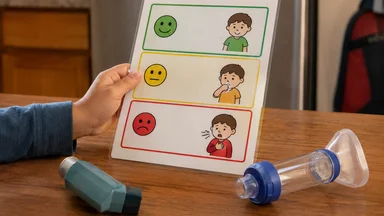
Asthma action plans—typically a one-page document dividing symptoms into green (well-controlled), yellow (caution), and red (emergency) zones—are a cornerstone of national asthma guidelines. The National Heart, Lung, and Blood Institute recommends that every child with asthma receive a written plan, updated at each visit. In theory, the plan empowers parents to adjust medication and seek care before an attack escalates. In practice, many families never open the laminated folder once they leave the clinic.
At a community clinic in the Humboldt Park neighborhood, a 2022 audit of electronic health records revealed that only 18% of children with asthma had a documented action plan that had been reviewed within the past year. Even when plans were present, parents reported confusion over the color zones. “I know green means good, but what exactly am I supposed to do when he coughs at night?” one mother told a researcher. The plans often use medical jargon—such as “peak expiratory flow rate” or “inhaled corticosteroid”—that assumes a level of health literacy many caregivers lack.
The clinic staff, stretched thin, rarely have time to explain the plan thoroughly. A typical pediatric visit lasts 12 minutes, during which the clinician must address vaccines, growth, and developmental milestones. The asthma plan is handed over with a quick “follow the colors.” No one calls to check if the family understood. “We hand it out like a flyer,” a nurse practitioner admitted to me, speaking on condition of anonymity because she was not authorized to discuss clinic operations. “We assume it’s common sense, but it’s not.”
Compounding the problem, plans are often printed in English only, or in Spanish translations that are overly formal and fail to capture colloquial terms. A 2021 study from the University of Illinois at Chicago found that Spanish-language plans used phrases like “utilice el inhalador de rescate” rather than simpler alternatives. Parents reported that the instructions felt “like a legal document, not something for my child.” The result: the plan goes into a drawer, and the child’s asthma remains managed by trial and error.
Why Parents Put the Plan in a Drawer
Language is one barrier, but trust is another. In a 2024 Pew Research Center survey titled “Americans’ Health Information Behaviors and Social Media Use,” 40% of Americans—and half of adults under 50—said they turn to social media influencers for health advice rather than their doctor. Among low-income communities of color, the numbers are similar. Distrust of the medical system, rooted in historical abuses and everyday dismissals, leads many parents to rely on grandmothers, neighbors, or TikTok videos for asthma management.
“The doctor doesn’t know my kid,” a father in the Englewood neighborhood told a community health worker. “He saw him for ten minutes. My mother knows his cough better.” This sentiment is not unfounded. Studies show that clinicians in busy public clinics often miss subtle cues about a family’s living situation, such as mold in the apartment or a caretaker who smokes. Without that context, the action plan feels generic and irrelevant.
Work schedules add another layer. Many low-income parents work irregular hours or multiple jobs, leaving little time for daily symptom tracking or peak flow measurements. “I’m supposed to write down his symptoms every morning?” a mother of three asked rhetorically. “I’m lucky if I remember his lunch.” The action plan, designed for a world of predictable routines, collides with the chaos of poverty.
Fear of stigma also plays a role. Some parents worry that if their child uses an inhaler at school, they will be labeled as “sickly” or bullied. Others report that school nurses discourage inhaler use unless the child is visibly struggling, contradicting the action plan’s advice to medicate at the first sign of yellow-zone symptoms. The plan, intended to give families control, instead becomes a source of anxiety.
The Clinic Visit: 12 Minutes and a Form
The 12-minute pediatric visit is a well-documented bottleneck. In a 2023 analysis of primary care workflows, researchers found that clinicians spend an average of 90 seconds on asthma education during a well-child check. The rest of the time is consumed by documentation, vaccine counseling, and addressing acute complaints. The asthma action plan is often printed by a medical assistant and handed to the family at checkout, with no dedicated discussion.
Nurse-led education, when available, is inconsistent. Some clinics employ a nurse educator who reviews the plan in a separate room, but funding for such positions is precarious. Across Chicago’s network of federally qualified health centers, only 3 of 12 sites had a dedicated asthma educator in 2024. At the others, the task falls to the primary clinician, who may lack training in teach-back methods—a technique where the patient repeats instructions in their own words to confirm understanding.
Digital tools, which could bridge the gap, are underused. Most clinics offer patient portals, but fewer than one in four families in low-income Chicago neighborhoods have activated their accounts, according to a 2024 study. The portals could host digital action plans with video demonstrations, but they remain static PDFs. Meanwhile, a 2026 Vox report by reporter Keren Landman, MD, titled “AI Diagnosis Tools Are Outperforming Physicians in Emergency Settings,” highlighted how AI tools are transforming acute care, yet the primary care infrastructure for chronic disease management lags behind. The technology exists; the will to deploy it in safety-net clinics does not.
Follow-up is rare. After the initial visit, no one calls to ask whether the family has questions or whether the child’s symptoms have changed. The plan becomes a static document, not a living tool. “We treat it like a prescription,” a pediatrician told me. “But a prescription you fill once. This needs to be refilled with every season, every trigger change. We don’t have the bandwidth.”
Some clinicians argue that even if action plans are underused, they still serve a purpose. “Having the plan in the home, even if it’s in a drawer, means the information is there when a crisis hits,” says Dr. James Chen, a pediatric pulmonologist at the University of Chicago. “In an emergency, a parent might grab that laminated sheet and bring it to the ER. It’s not ideal, but it’s better than nothing.” Others point out that the mere act of printing the plan prompts the clinician to discuss triggers and medications, which may have educational value even if the plan itself is not referenced later. However, these arguments do not address the systematic failures in implementation that leave many families without effective support.
What Works: Lessons From a South Side Pilot
In 2023, a pilot program launched in three South Side clinics attempted to close the gap. The intervention was simple: community health workers—trained laypeople from the same neighborhoods—were assigned to coach families on using the action plan. They made home visits, sent text reminders tied to the color zones, and helped parents identify triggers like dust or cold air. The results were striking. After six months, emergency department visits for asthma dropped by 30% among enrolled children, and hospitalizations fell by a similar margin.
The program also simplified the plan itself. Instead of the standard three-color grid, the pilot used a one-page visual guide with icons: a smiling face for green, a frowning face for yellow, and a siren for red. Instructions were reduced to three bullet points per zone. “My mom can read this,” one 10-year-old participant told a health worker. The simplified plan, co-designed with parents, was printed on waterproof paper and attached to the refrigerator with a magnet.
Text reminders proved particularly effective. Families received messages like “Is your child coughing more than usual? Check the yellow zone on your plan.” The messages were sent in English or Spanish, depending on preference, and timed to avoid work hours. A separate study found that 80% of parents who received texts felt more confident managing their child’s asthma, compared to 45% in the control group.
Coordination with school nurses was another success. The pilot established a direct line between the clinic and the school health office, so that when a child used their inhaler at school, the nurse could notify the clinic within 24 hours. This allowed clinicians to adjust the plan proactively, rather than waiting for a crisis. The pilot’s coordinator, a nurse practitioner, told me, “We stopped treating the plan as a handout and started treating it as a conversation. That made all the difference.”
Yet, the pilot’s results may not replicate in all settings. The clinics involved had unusually strong community ties and a dedicated grant that funded the health workers. In a less resourced setting, the same model might yield smaller gains. “We had a motivated team and extra money,” the coordinator acknowledged. “Scaling that without the same support is the real challenge.”
The Reimbursement Trap for Prevention
Despite the pilot’s success, scaling it faces a familiar obstacle: money. Medicaid, which covers most children in low-income Chicago clinics, reimburses for a visit but not for the 30-minute coaching session a community health worker provides. The billing codes for asthma education exist—Current Procedural Terminology codes 98960 and 98961—but they are rarely used because they require a licensed health professional to be present, a rule that excludes community health workers in many states.
Federally qualified health centers operate on a capitated payment model, meaning they receive a fixed amount per patient per month regardless of services provided. This creates a disincentive to offer time-intensive preventive services like asthma coaching. “Every minute I spend on a phone call with a family is a minute I’m not billing for a visit,” a clinic administrator explained. The math is brutal: a 15-minute asthma coaching call costs the clinic roughly $30 in staff time, but generates no additional revenue.
Some states have experimented with value-based payment models that reward outcomes rather than volume. In Illinois, a 2025 Medicaid demonstration project provided bonus payments to clinics that reduced asthma hospitalizations by 10% or more. Early results are promising, but the program covers only a fraction of the state’s clinics. Meanwhile, the majority of safety-net providers remain in a fee-for-service system that pays for procedures, not prevention.
The irony is that asthma coaching saves money overall. A 2022 analysis by the Chicago Department of Public Health estimated that every dollar spent on community health worker asthma coaching saved $3.50 in emergency care costs. But those savings accrue to the health system, not to the clinic that pays for the coaching. Until reimbursement models align with the evidence, the action plan will remain a paper shield that rarely opens.
Rethinking the Action Plan as a Living Tool
What if the action plan were not a piece of paper but a process? Researchers at the University of Chicago are testing a “living action plan” that updates automatically based on seasonal triggers. In spring, the plan adds reminders about pollen; in winter, it warns about cold air and indoor smoke. The plan is delivered via a smartphone app, with push notifications and a QR code that links to a video demonstration of spacer use. Early feedback from a small trial suggests that families prefer the app to paper, but access to smartphones and data plans remains uneven.
Co-design with parents is emerging as a best practice. In a 2024 workshop, parents from the South Side suggested using pictures of their own children on the plan to make it feel personal. They also requested that the plan include a section for the school nurse to initial after each inhaler use, creating a record that parents could see. “It’s about making the plan ours, not the doctor’s,” one mother said. The resulting prototype is now being tested in three clinics.
Integration with school health records is another frontier. If a child’s action plan is accessible to the school nurse via a shared electronic record, the nurse can administer medication according to the plan without needing a parent to bring a copy. A pilot in Chicago Public Schools, launched in 2025, showed that such integration reduced medication errors and improved response times during asthma attacks. But interoperability between clinic and school systems remains a technical and bureaucratic challenge.
Ultimately, the action plan must shift from a one-time handout to an ongoing conversation. That requires time, trust, and reimbursement reform—none of which are easy. As one clinician put it, “We know what works. The question is whether we’re willing to pay for it.” For now, in low-income Chicago clinics, the laminated sheets sit in drawers, waiting for a system that treats prevention as more than an afterthought.